
How to Search Gladwin County Property Records
Three systems divide the work in Gladwin County. For an address, owner name, or parcel number, BS&A Online is the practical first stop. It also handles the current-tax and delinquent-tax route. Recorded instruments live elsewhere. Gladwin iDoc indexes deeds, mortgages, releases, easements, liens, and plats. For map context, FetchGIS shows parcel shape, taxing unit, situs, legal-description and assessment fields, and the surrounding geography.
Each source answers a different question. The assessment roll names the owner carried for tax administration. The newest recorded deed better confirms a recent transfer. The GIS drawing helps locate the tax parcel but is not a survey. Keep the parcel number and legal description together while moving between systems. A Gladwin County property records search stays on track that way.
- Enter the street address in BS&A, then record the parcel number and displayed owner.
- Use that owner, the prior party, or the legal-description fields in iDoc to locate the relevant deed.
- Choose the current- or delinquent-tax path appropriate to the tax year and payment status.
- Open FetchGIS, identify the parcel, and turn on municipal boundaries or other useful layers.
- Obtain the recorded image or a certified copy from the Register of Deeds when the index card is not enough.
Gladwin County Property Records Offices
Copies of recorded land instruments come from the Register of Deeds. Equalization maintains county assessment databases and mapping support. City and township assessors create the local rolls. The Treasurer takes delinquent real-property taxes once the local collection period closes. All three county offices sit at the courthouse complex in the City of Gladwin, but their records are not interchangeable.
Gladwin County Register of Deeds
401 West Cedar Avenue
Gladwin, MI 48624
989-426-7551
Gladwin County Equalization
555 West Cedar Avenue
Gladwin, MI 48624
989-426-9327
Gladwin County Treasurer
401 West Cedar Avenue
Gladwin, MI 48624
989-426-7251
Gladwin iDoc Separates Index Leads From Record Copies
The Register of Deeds' public iDoc screen accepts many search routes. Options include recording date, document number, book and page, and instrument type. Party name, subdivision, lot and block, and section-township-range work too. So do legal text and assessor number. That breadth matters. A name-only search can return too much. A broad deed query runs into the system's 1,000-card cap. Narrowing by date, role, instrument, or legal description produces a far more usable set.
An iDoc card is an index lead, not the document itself. A deed card shows its document identifier and recording date. It also lists page count, grantor, grantee, and the first legal-description clue before the View control. Images require a subscription or pay-per-print. County guidance places indexed images from January 1, 1952. Certified-image coverage begins in March 1991. One quirk: document-number searches before February 18, 2016 require five digits.
| Known clue | Useful iDoc field | Refinement |
|---|---|---|
| Person or entity | Party name and role | Try grantor and grantee separately |
| Platted property | Subdivision, lot, block | Retain historic spelling variants |
| Rural description | Section, township, range | Pair with legal-text terms |
| Recorded reference | Document or book/page | Use five digits for older document numbers |
Read the Gladwin BS&A Search Modes Before Choosing One
BS&A offers three routes: All Records, Current Tax, and Delinquent Tax. Each is searchable by address, owner name, or parcel number. Start with All Records when the question spans assessment and tax status at once. Current tax stays a city or township responsibility through February 28. Delinquent real-property tax transfers to the county on March 1. That custody change explains a common puzzle. A current bill and a county delinquency search can point to different offices without contradicting each other.
The parcel or GIS record can show a lot of fields. These include OwnerName1 and OwnerName2, situs and mailing addresses, assessment year, property class, taxing unit, and school district. Also there: assessed value, taxable value, state equalized value, principal-residence-exemption information, tax status, acreage, zoning, legal description, and sale references. Treat those fields as cross-references. The tax-roll name may not yet reflect a just-recorded closing.
The official Gladwin BS&A entry screen visibly distinguishes the three record modes:
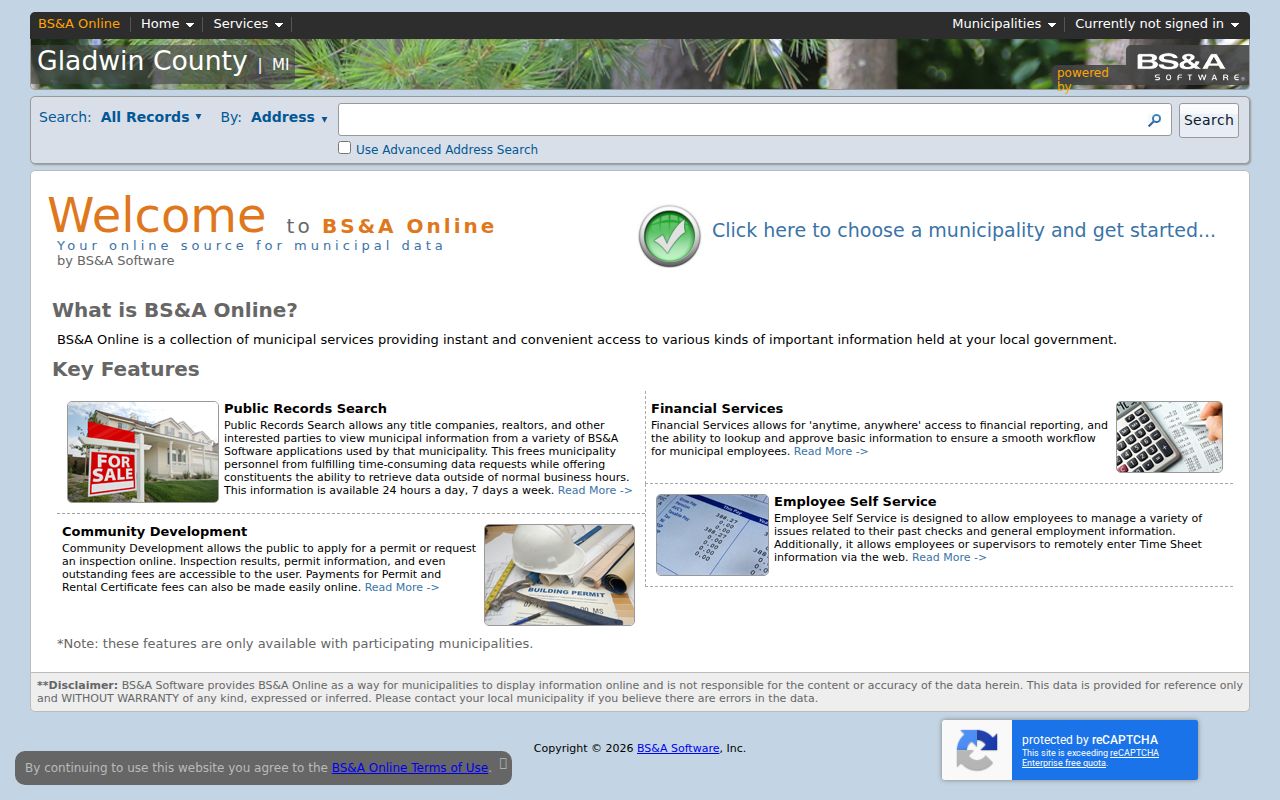
That opening choice is the quickest way to avoid treating a locally collected current account as a county-held delinquency.
Types of Gladwin County Property Records
A parcel's public history spreads across instruments, assessment entries, tax accounts, map layers, plats, and permit files. No single portal holds every answer. Match the record to the question, and the results hold up better.
| Gladwin record | Primary evidence | Custodian | Practical access |
|---|---|---|---|
| Deeds | Recorded conveyance, parties, legal description | Register of Deeds | iDoc index; paid image or office copy |
| Mortgages, releases and liens | Recorded claims and later discharges | Register of Deeds | iDoc, counter, mail request |
| Assessment and taxes | AV, SEV, taxable value, PRE, account status | Local assessor and treasurer; county after delinquency | BS&A and official offices |
| Parcels and plats | Tax-parcel context, lot/block, recorded subdivision | Equalization, Register, state plat program | FetchGIS, iDoc, LARA Accela |
| Construction and land use | Applications, approvals and inspections | County Construction Codes or city office | Office forms and records request |
For the recorded chain, use Gladwin County deed records. For assessed values, exemptions, payment responsibility, and appeal routes, turn to Gladwin County property tax records. The parcel maps guide shows how the geography connects those files.
Map a Gladwin Parcel Without Mistaking the Line for a Survey
FetchGIS locates a parcel by PIN, owner, or street. Layers can be added for imagery, parcels, subdivisions, streets, water, municipal boundaries, zoning, flood information, contours, and Public Land Survey System context. Aerial coverage includes 2010, 2015, 2020, and 2024 imagery. Selecting a polygon exposes the configured parcel fields. Buffer tools can identify affected nearby parcels and export results to CSV.
The viewer states its own limitation plainly: mapped parcel lines are for reference. They do not establish a surveyed boundary, an easement, or title. Confirm a lot-and-block description through the recorded plat. Take a metes-and-bounds dispute to the deed, related surveys, and a licensed surveyor. Michigan's Tax Parcels directory also points to the Gladwin viewer and supplies statewide context.
Gladwin Plats Connect Modern Parcels to Older Names
Subdivision research in Gladwin County opens through several official doors. iDoc is one of them. It includes plat map, subdivision, lot, and block fields. Michigan LARA explains the Land Division Act process. It also provides an Accela search for subdivision and final-plat review material. Historic General Land Office plats are available through the Michigan DNR directory. The Library of Michigan guide adds plat-book leads. Public-library catalogs list later plat books and city maps.
Names outlast street labels. Official City of Gladwin minutes preserve the Plat of Cedar, C.C. Fouch Addition, and Foutch and Johnson's Addition. The Fouch/Foutch variation is a real search trap. Search both forms. Then compare the legal description instead of assuming one spelling is an error. In the City of Gladwin, "Cedar" is a working records term. It is also the settlement's former name.
The state's subdivision page explains the official review route. It is illustrated by the LARA subdivision program:
Use the state trail for plat status. For parcel-specific evidence, rely on the recorded county instrument and the legal description.
Follow Gladwin Taxes From Local Collection to County Delinquency
Summer and winter taxes in Gladwin County begin with the city or township treasurer. Current real-property tax is paid locally through February 28. Anything unpaid becomes county delinquent tax on March 1. From there, the Gladwin County Treasurer handles delinquency, forfeiture, foreclosure notices, and the auction route. Payment runs through the official GovPros form. It asks for parcel number and tax year and warns of a service fee, so confirm the parcel identity and balance before paying.
Calendar distinction. “Current” and “delinquent” describe both status and custodian in Gladwin County. A missing county balance before March 1 does not show that the local bill was paid.
Assessment disputes follow a different route. Michigan assesses property at 50 percent of true cash value, subject to equalization. Three values matter here. The state distinguishes assessed value, state equalized value, and taxable value. The local Board of Review uses the L-4035 petition process, and further appeal may reach the Michigan Tax Tribunal under issue-specific deadlines.
Use Gladwin Document Alerts as a Monitoring Tool
Gladwin County offers a free iDoc Document Alert, also promoted as a Fraud Alert. Registration covers name or property recording activity. The account screen is a notification gateway. It is not title insurance. An alert does not block recording or decide validity. Nor does it replace periodic review of the deed index. The Gladwin alert setup visibly begins behind an account or login step:
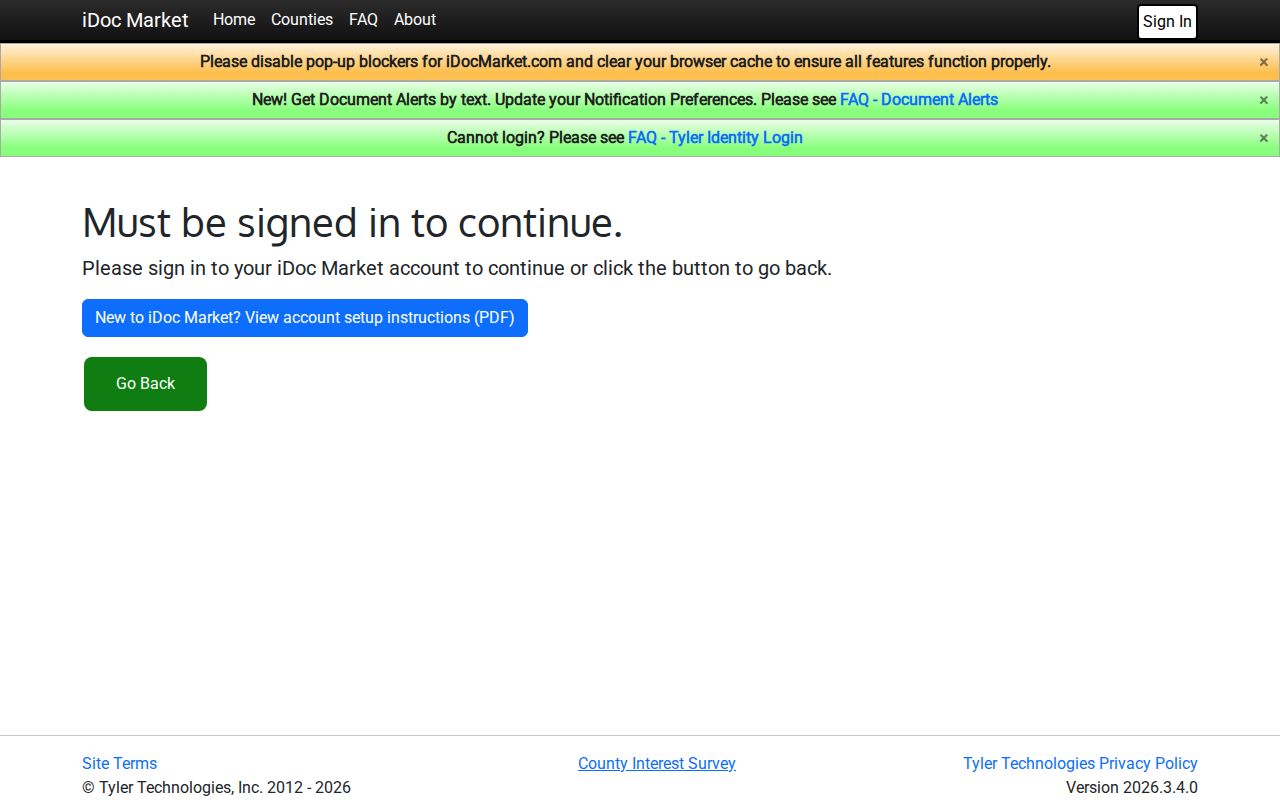
An unfamiliar notice deserves a careful check. Compare its document number and parties in iDoc. Contact the Register of Deeds through the county's published number, never through details supplied with an unsolicited message.
Reach Gladwin Records That Are Not Fully Online
Some Gladwin County records still need a human. The Register of Deeds counter and written-request route matter when an image predates the online range. They also matter when a scanned page is unreadable or certification is required. Copies cost $1 per page. Certification adds $5. Staff searches run $0.50 per year with a $5 minimum, except for tract-index work. Those differ from iDoc's subscription or per-image access.
Deeper history lives in state collections. The Archives of Michigan county guide identifies Gladwin assessment rolls for 1875–1895. It also lists tax rolls for 1896–1945. The Library of Michigan's Gladwin guide adds newspapers, obituary and naturalization indexes, local histories, and plat-book leads. These collections can bridge a pre-1952 ownership clue, but not a complete deed chain. Use names, legal descriptions, tax years, probate files, and newspaper notices as connecting evidence.
Michigan FOIA opens another door. It covers existing public records an office has not posted. A written request must describe the record well enough to locate it. For land material, include the parcel number, street address, legal description, record type, office, and date range. The Attorney General's guidance allows five business days. It also allows one written extension of up to ten business days. Responses can grant, deny, grant in part, or extend. Exempt material may still be withheld or redacted.
The custodian matters more than the request label. Deed and recorded-instrument questions go to the Register. Assessment and mapping questions belong with Equalization or the local assessor. Delinquent-tax questions go to the Treasurer. Permit or address-assignment questions go to Construction Codes. MiCOURT may offer only an informational case listing. The County Clerk and relevant court retain the full files. This office-first approach cuts search time. It also reduces the risk of treating a portal summary as the underlying record.
Distinguish Gladwin, Beaverton and Postal Geography
Gladwin County has exactly two incorporated cities, Gladwin and Beaverton. Fifteen townships fill out the rest of the map. ZIP codes don't draw those borders. A 48624 mailing address can fall outside the City of Gladwin. A 48612 label can describe rural property well beyond Beaverton. For the jurisdiction question, FetchGIS offers two layers worth trusting: Municipal Boundaries and TaxingUnit. USPS lookup answers the separate mailing question.
The split matters for taxes. Zoning questions and municipal property records start there. It also keeps Sugar Springs in its proper place. Sugar Springs is a large named community with its own map and directory history, not a third city. Deeper detail waits in the Gladwin property records and Beaverton property records guides.
Old place names add a second layer of geography. Gladwin was once called Cedar. Plat of Cedar still appears in modern legal descriptions inside city minutes. Beaverton's past holds Grand Forks and the Tobacco and Cedar river setting. Out in the townships, a section, township, range, subdivision, resort name, or taxing unit may pinpoint land better than a postal city. Keep each old spelling exactly as written. Then match the deed description against current FetchGIS layers and the assessor number.
The iDoc sample deeds show why that care pays off. One deed card lists Boman's Secord Dam Resort as its First Legal field. No street address anchors the land. A similar search may demand SECORD TOWNSHIP, a subdivision name, or lot and block data. Postal geography gets mail delivered. Recorded and tax geography identify which land and which public office the records concern.
What Gladwin County Property Records Can and Cannot Tell You
Official Gladwin County property records carry real weight. They can name the owner carried on an assessment roll. They can show recorded transfers and encumbrances. They can also supply assessed and taxable amounts, locate a tax parcel, and point to plats or permits. But limits exist. They cannot guarantee marketable title. They cannot determine an unrecorded interest, prove occupation or residence from a mailing address, establish a boundary, or provide a market appraisal. A deed-index card is not a certified deed. A GIS polygon is not a survey.
Lawful use. Gladwin County property records support purchase due diligence, boundary research, tax appeals, estate work, house history, and civic transparency. They do not replace a title professional or licensed surveyor, and Michigan law prohibits stalking or harassment.