
Trace Gladwin County Former Owners Across Record Eras
No single database holds every prior owner. Gladwin County's iDoc images mark the modern starting point. The Register of Deeds keeps the older deed-book and tract-index route. State collections add dated tax roll and assessment evidence. Treat the table as a map of time depth, not a promise that any series is complete.
| Source | Years It Covers | Where Held | What It Shows |
|---|---|---|---|
| iDoc GLAMI1 images | January 1, 1952 to present | Online index; Register of Deeds | Recorded instruments, parties, dates, book/page, and legal clues |
| Earlier deed books and tract indexes | Before the online image boundary; earliest year not stated online | Register of Deeds counter or written request | Older conveyances tied to legal descriptions and tracts |
| Assessment rolls | 1875 to 1895 archival holdings | Archives of Michigan | Assessed persons and property context by roll year |
| Tax rolls | 1896 to 1945 archival holdings | Archives of Michigan | Taxed owners or parties and land context by year |
| Plat books and atlases | 1906 atlas plus later cataloged county/city map runs | Library, state plat resources, and Register | Lot, block, subdivision, and mapped owner clues |
Begin online for transfers inside the image period. For earlier former owners, carry the last confirmed legal description straight to the Register. Archival rolls and maps serve as corroboration only, since a tax or atlas name is evidence for one year, not a conveyance by itself.
Start Gladwin County's Prior-Owner Trail at the Current Grantee
Start the backward chain with the newest recorded deed affecting the parcel. Its grantee received the interest. Its grantor is the immediately prior owner or conveying party. Before stepping back, note the document number and date. Also note the book and page, instrument type, and legal description. Those details anchor every link that follows. Skip the remembered surname when the land itself can be pinned down more firmly. The Gladwin iDoc index accepts assessor number and legal text along with party names. Subdivision, lot, and block are useful controls. So are section, township, and range. These keep two similarly named parties from collapsing into one history.
Keep Gladwin County Former Owners Tied to the Land
Older Gladwin County instruments often carry no street address at all. Legal identity lives in a platted lot and block or a section-township-range call instead. Search iDoc's Legal field with a stable place name. Then narrow by date and party role. Spelling variants and partial-name matching help when a surname or entity changes form over time. The portal also preserves local quirks worth knowing. Its Instrument Group list includes BUTMAN, GROUT, REMON REPORT, and SECORD TOWNSHIP. The range options even carry an apparent “O2E” spelling. Exact portal language can become a search key of its own. A broad deed inspection returns 1,000 cards. A date band or legal field is essential when reconstructing previous owners. The official Gladwin iDoc search screen displays how the controls combine. Party, instrument, date, legal-description, and parcel controls work together.
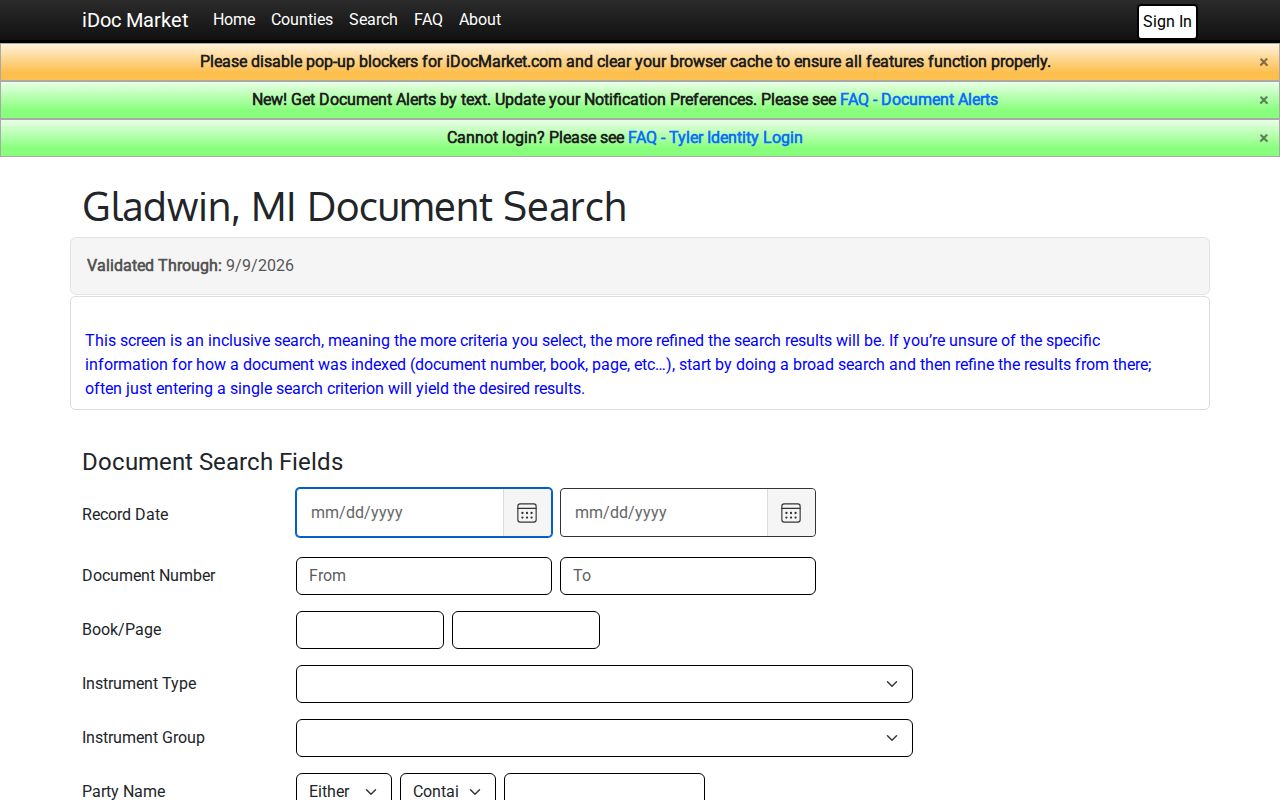
Use those controls to isolate one transfer at a time. The search screen narrows a lookup; it does not display a complete ownership chain.
Note: When names conflict, treat the legal description and parcel cross-reference as the thread that keeps the history on the same land.
Walk the Gladwin County Deed Chain Backward
Each pass answers one question. Who conveyed this same property to the person already in the chain? Repeat the move with care, preserving dates and citations so two people sharing a name are never treated as one.
- Find the newest conveyance and confirm that its legal description matches the subject parcel.
- Enter its grantor in the next search, then look for the earlier deed where that party appeared as grantee.
- Compare legal text, dates, instrument numbers, book/page references, and parcel identifiers before accepting the match.
- Repeat until the trail reaches the online image boundary, then request the corresponding older index or deed book from the Register.
- Grantor
- The party conveying an interest; often the prior owner in a sale.
- Grantee
- The party receiving the interest stated in the instrument.
- Chain of title
- The ordered sequence of instruments that purports to connect ownership through time.
- Reverse index
- An index arranged to find instruments through a grantee or other party role.
- Quitclaim and warranty deed
- Different conveyance forms whose legal effect must be read from the actual instrument.
Recognize Gladwin County Estate Transfers in the Chain
A clean grantor-to-grantee rhythm can break when death or fiduciary action intervenes. Sampled iDoc cards include grantors described as “PR FOR EST OF,” showing how a personal representative conveys estate property. A probate court order, death certificate reference, certificate of trust, or fiduciary deed can bridge the gap. Search the estate name, decedent name, personal representative, and legal description as separate variants. For the local file or fiduciary authority, consult the Gladwin County 17th Probate Court when public access permits. MiCOURT is only an informational index. The court keeps the official file.
Chain clue. An estate abbreviation is not a dead end. It signals that probate authority and the recorded conveyance must be read together.
Bridge Gladwin County's Pre-1952 Ownership Record
iDoc's published image coverage starts January 1, 1952. Certified online images start in March 1991. Former owners before 1952 are not absent; the search simply changes channel. Contact the Gladwin County Register of Deeds at 401 W. Cedar Avenue or 989-426-7551 with the last known party, date range, and legal description. Include a book or page lead. Ordinary copies run $1 per page. Certification costs $5. A staff search is $0.50 per year with a $5 minimum. Tract-index searches require contacting the office directly. Mail requests work well when a counter visit is impractical. Michigan FOIA offers another written-record route. A direct custodian request is often clearer for a named deed book.
Note: For iDoc document numbers before February 18, 2016, enter five digits; the county gives 01069-00172 as its format example.
Follow Cedar and Plat Names Through Gladwin County History
Historic place language can rescue a stalled chain. Gladwin was formerly known as Cedar. Official city minutes preserve “Plat of Cedar” alongside C.C. Fouch Addition and Foutch and Johnson's Addition. Search both Fouch and Foutch. A legal-description match beats assuming either spelling is an error. The 1906 Ogle atlas adds county outlines, city and township plats, landowner and patron directories, and a business directory. The Library of Michigan Gladwin guide points to plat books and newspapers. It also covers obituaries, cemetery, and naturalization indexes. These materials can identify a person or place between deeds. The recorded conveyance remains the chain evidence.
Test Former Gladwin County Owners Against Dated Archives
Early records live in the Archives of Michigan county guide. Assessment rolls from 1875 through 1895 and tax rolls from 1896 through 1945 show who was tied to land in a given year, helpful when an old deed is hard to read or a parcel description changed. Naturalization declarations from 1875 through 1952 and corporation papers from 1887 through 1970 can add context about a name.
Local newspapers round out the picture. The Gladwin County Record has cataloged runs from 1878 to 1959 and 1987 to 1991, while the Beaverton Clarion covers 1895 to 1916. Notices, probate reports, and obituaries often explain a transfer. Treat them as support, though. A deed remains the record that settles ownership.
Know Where Gladwin County's Former-Owner Chain Stops
Gladwin County was laid off in 1831 and organized in 1875. The county publishes no official statement of its earliest surviving deed book. No complete online index lists a start year either. No courthouse fire or broad records loss appears in the county's own accounts. A sound former-owner chain therefore ends at the last documented instrument. It does not end at a guessed first owner.
Lawful use. Trace former Gladwin County owners for house history, estate work, or property diligence. Never use a historical trail to track, threaten, or harass a living person.
A gap in the chain may call for a professional title search, particularly where corrective deeds, quitclaims, foreclosures, probate orders, or rewritten legal descriptions intervene. Need today's name instead of the backward chain? Use the current-owner record guide.