
Read Gladwin County Deed Records by Instrument Type
The Gladwin County Register of Deeds records far more than deeds. Mortgages, assignments, discharges, easements, liens, plats, mineral instruments, foreclosure papers, and probate orders all sit in the same official record books. The instrument label tells you what a document does at a glance. Only the recorded image carries the full legal language, though.
| Deed Type | What It Does | Common Use |
|---|---|---|
| Warranty deed | Conveys the stated interest with deed covenants. | Ordinary arm's-length transfers. |
| Quit claim deed | Conveys whatever interest the grantor holds. | Family, estate, or title-cleanup transfers. |
| Sheriff's deed | Records a transfer following the applicable process. | Foreclosure-related research. |
| Mineral deed | Conveys a stated mineral interest. | Separating subsurface from surface interests. |
| Probate court order | Records court authority affecting an estate interest. | Fiduciary and heir-chain research. |
Remember that a mortgage or lien is an encumbrance, not a deed. Before assuming one still burdens the parcel, look for its discharge, release, assignment, or a later court order.
Search the Gladwin iDoc Deed Index Precisely
The GLAMI1 iDoc search offers many ways to narrow a deed search. Filters include date range and document number. Book and page, instrument type and group, and party role are options too. You can also search by subdivision, lot and block, section, township and range, or legal text. An assessor number works as well. Five different name-match modes are available. Start narrow. A broad DEED query can hit 1,000 result cards.
| Index field | Choices or format | Best use |
|---|---|---|
| Party Type | Grantor, Grantee, Either | Follow a transfer forward or backward. |
| Name match | Starts With, Contains, any word, Ends With, Equals | Handle trustees, estates, entities, and punctuation. |
| Legal | Subdivision, lot, block, section, township, range, free text | Separate same-name owners and historic addresses. |
| Assessor Number | Four match modes | Bridge a current parcel card to recorded documents. |
The official index pictured here displays the unusually broad filter set.
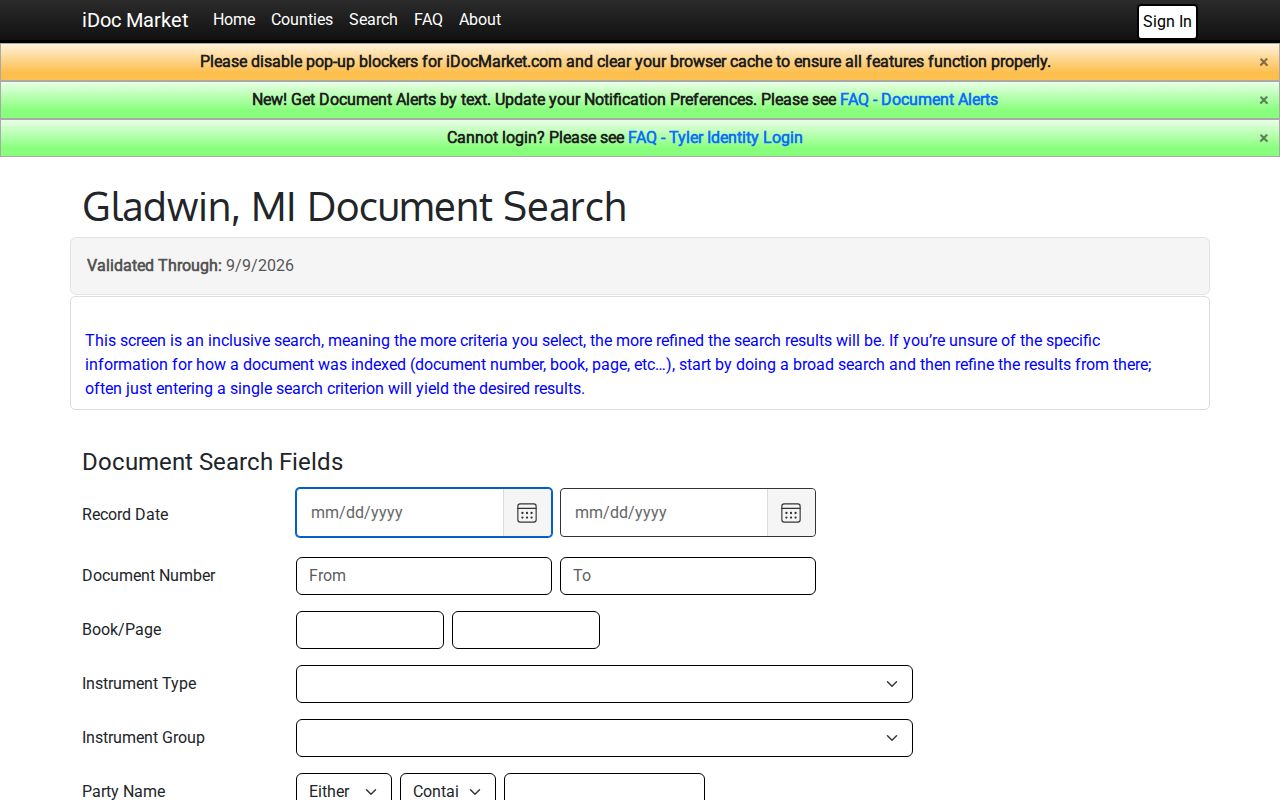
These fields let you pair a party name with a parcel identifier, so the land itself confirms the match.
Account for Gladwin County's Index Quirks
Older indexing habits show up in iDoc. Documents recorded before February 18, 2016 need a five-digit document number. The instrument dropdown keeps both JUDGEMENT and JUDGMENT. It also holds truncated labels and legacy spellings like EQUILIZATION, Tranfers, and O2E. Groups even include BUTMAN, GROUT, SECORD TOWNSHIP, and REMON REPORT.
Work in steps. Try exact portal spellings first. Then run a Contains name search. Then move to the legal fields. Historic Gladwin city land may sit under Cedar instead. Fouch and Foutch variants both appear in official city material.
Note: An index miss may reflect spelling, role, date, or format. It does not always mean a recorded document is missing.
Walk the Gladwin County Grantor-Grantee Chain
A backward chain starts with the most recent document that acquired the land. At every step, confirm the parcel through the assessor number and legal text; a shared name alone can lead to an entirely different parcel.
- Find the present owner's latest deed with that owner as grantee.
- Read its grantor, recording date, book/page, instrument number, and legal description.
- Search that grantor as a prior grantee and confirm the same land.
- Repeat until online images stop, then continue through the Register's older books or indexes.
- Grantor
- The party conveying the stated interest.
- Grantee
- The party receiving that interest.
- Chain of title
- The ordered series of conveyances affecting the same land.
- Book/page and instrument number
- Two recorded-document references used by the index.
Read a Gladwin iDoc Result Card
A typical iDoc result card, such as document 1121-226, shows the full structure at a glance: instrument, document number, book 1121, page 226, record date, page count, grantor, grantee, First Legal, and a View control. That First Legal field can carry a plat or community name like Boman's Secord Dam Resort. It identifies land even with no street address present.
Cards sometimes show shorthand like “PR FOR EST OF,” a hint that probate or a fiduciary act explains the transfer. The card itself is only an index abstract. The paid image or office copy supplies the full operative text.
Cross the 1952 Gladwin Image Boundary
The iDoc county listing places online images from January 1, 1952 to the present, with certified images from March 1991 forward. Those dates mark image cutovers, not the start of Gladwin County deed records. For older chains, ask at the Register counter or send a focused request with names, dates, and land descriptions.
The Archives of Michigan Gladwin guide adds assessment rolls from 1875-1895 and tax rolls from 1896-1945. Library plat books, the 1906 Ogle atlas, and historic newspapers can bridge owner and place clues. None of them replaces the deed itself, though.
The Register remains the first fallback for early deed books and indexes. Give staff the last confirmed grantor or grantee. Also give an approximate transfer year and the period legal description. Assessment and tax rolls can suggest who held the land in a given year. A newspaper notice or atlas may offer another spelling. Clues like these help you find the next recorded deed. But none belongs in the chain as if it were a conveyance.
No courthouse fire or broad records loss appears in Gladwin County's official history. So don't explain a missing result with a disaster claim. Test index spelling first. Then check party role, document format, date range, and the gap between online image coverage and the office's older holdings. That gap often explains the missing result.
Match Deeds with Releases and Later Instruments
A Gladwin County deed never travels alone. It sits inside a longer instrument trail, and the deed records only tell part of that story. A careful property search pairs each deed with whatever came after it. That means matching mortgages against their assignments and discharges. It also means matching claims of lien against releases, and easements against any instrument that clears them. Lis pendens entries should be traced to their later disposition. An original deed should also be checked against corrective deeds, quitclaims, or probate orders.
The instrument list runs wide. It includes PLAT MAP, SURVEY, RIGHT OF WAY, LAND CONTRACT, JUDGMENT OF FORECLOSURE, and many partial-release types. So a deed-only query can miss documents that touch the same legal description. That is why a recorded deed is evidence, never a complete title conclusion.
Mortgage trails can sprawl. One chain may involve the original lender, several assignees, and a discharge recorded under a later party's name. Search both sides of the assignment. Compare the affected instrument number each time. A partial release deserves extra care. It may free only part of the land or part of the debt. The same caution applies to partial releases of liens, leases, and lis pendens. Read the land description and the referenced document instead of inferring scope from an index label.
Court-linked records need two custodians. iDoc can surface a circuit or probate order, lis pendens, judgment, or foreclosure notice recorded against land. The case file itself lives elsewhere. It rests with the 55th Circuit Court, the 80th District Court, or the 17th Probate Court. MiCOURT is an informational public index only. It does not replace the clerk's file. Pull the case number and parties from one system. Then request the pleadings or order from the correct court.
Estate wording is a useful chain clue. Gladwin cards often read
which signals a personal representative acting for an estate. That phrasing can tie a fiduciary deed to a probate order. Before relying on it, confirm the legal description matches the parcel. Also check that no later corrective deed altered the names, shares, or land conveyed.
Monitor New Gladwin Recorded Documents
Gladwin County offers a free alert route through iDoc. The Fraud Alert or Document Alert feature can flag a newly recorded document tied to a watched name. It will not remove a filing, though. Nor is it title insurance. The Gladwin alert setup screen shown here sits behind an account and login gate.
Treat any alert as an early prompt. Inspect the actual instrument and contact the Register if a filing looks unfamiliar.
Obtain a Gladwin County Deed Copy
The Register of Deeds sits at 401 W. Cedar Avenue in Gladwin, MI 48624, open Monday through Friday from 8:30 a.m. to 4:30 p.m. The phone number is 989-426-7551. Online images run through iDoc subscription or pay-per-use access. The counter and written-request route still matter for older or missing material.
Copies cost $1 per page. Certifying a recorded document costs $5. A staff search runs $0.50 per year searched with a $5 minimum, except tract-index searches, which require direct contact. The $30 flat amount is the fee to record a document, not the price of an existing copy. Extra instruments in an assignment or discharge add $3 each.
The best request leans on the index itself. Include the document number, book and page, recording date, grantor, grantee, parcel number, and legal description. A street address alone can be weak. The recorded index tracks parties and land descriptions instead. Before mailing payment for an older or multi-page deed, ask about the procedure and the total charge.
Certification authenticates the office copy as the recorded document. It settles nothing about later corrections, probate orders, liens, releases, or other instruments that may have changed the record trail. Check the date sequence and the matching legal description before relying on one isolated image.
Recorded, not guaranteed. Gladwin County deed records show instruments accepted for recording. They do not certify clear title, resolve every unrecorded interest, or replace a professional title examination.